|
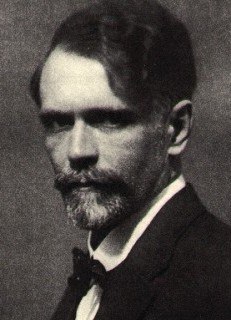 Zoltán Kodály was a composer and a music teacher. He was born on 26 December 1882 in Kecskemét. His mother and father also loved music, who themselves played music with pleasure. His mother played the piano and sang, his father played the violin. Zoltán Kodály started to play the violin then the cello during his music education. He sang not only in the choir of the cathedral, but also in the choir of the secondary school and he played in chamber orchestras, too. Zoltán Kodály was a composer and a music teacher. He was born on 26 December 1882 in Kecskemét. His mother and father also loved music, who themselves played music with pleasure. His mother played the piano and sang, his father played the violin. Zoltán Kodály started to play the violin then the cello during his music education. He sang not only in the choir of the cathedral, but also in the choir of the secondary school and he played in chamber orchestras, too.
His first works were composed at the end of the 1890s. He received his degree as a teacher of Hungarian and German languages in 1909. He was totally absorbed in the world of folk music, so he collected folk songs. He met Béla Bartók in the course of his work. After his study tours in Berlin and Paris he became a professor at the Music Academy in Budapest. In 1910 there were his composer's evening in Budapest and another performance by him in Zurich (Switzerland).
He and Béla Bartók founded Új Magyar Zeneegyesület (New Hungarian Music Association). In his publications he highlighted the importance of folk music and he published some Bartók analyses as well. He finished their common academic folk song publication called 'Erdélyi magyarság' (Transylvanian Hungarians) together with Béla Bartók. Some time later he entered into a contract with the Universal Edition firm in Vienna. The first performance of 'Psalmus Hungaricus' (Hungarian Psalm) achieved huge success in 1923.
In 1929-1930 he became well-known all over the world. Arturo Toscanini also played a role in it, who conducted several Kodály works in New York. Kodály's and Toscanini's friendship was more than music, the world famous conductor's daughter got married in Budapest. Kodály was the best man at the wedding ceremony. In 1933 there was the performance of his monumental work called 'Budavári Te Deum' (Te Deum of Buda Castle) which was on the London Radio two months later.
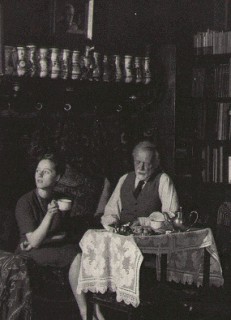 Besides composing and collecting folk songs Kodály also called attention to the connection between music, good ear for music and the spoken language. He considered musical education extraordinarily important and he was familiar with its past. Unfortunately history interrupted his work. After World War II he conducted his own works in the Soviet Union, Western Europe and America. Yehudi Menuhin asked Kodály to compose a violin concerto. In his last years he worked with incredible energy just like in his younger years. Besides composing and collecting folk songs Kodály also called attention to the connection between music, good ear for music and the spoken language. He considered musical education extraordinarily important and he was familiar with its past. Unfortunately history interrupted his work. After World War II he conducted his own works in the Soviet Union, Western Europe and America. Yehudi Menuhin asked Kodály to compose a violin concerto. In his last years he worked with incredible energy just like in his younger years.
In his life he did a lot for musical education both in Hungary and all over the world. He recognized the importance of musical education including school music education and the function of musical writing-reading. He studied, composed, taught and above all loved and enjoyed music. He died on 6 March, 1967, but his heritage is still alive.
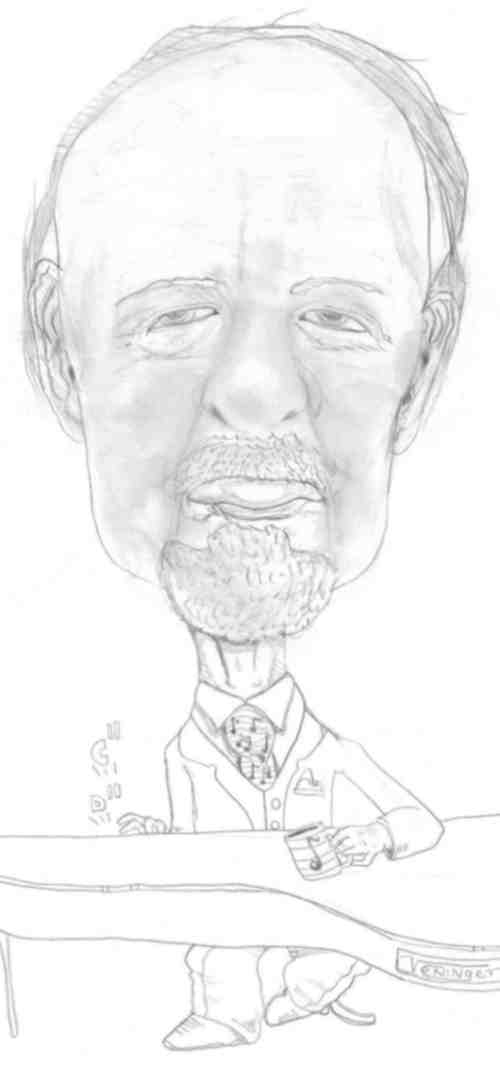
Zoltán Kodály - caricature
|